
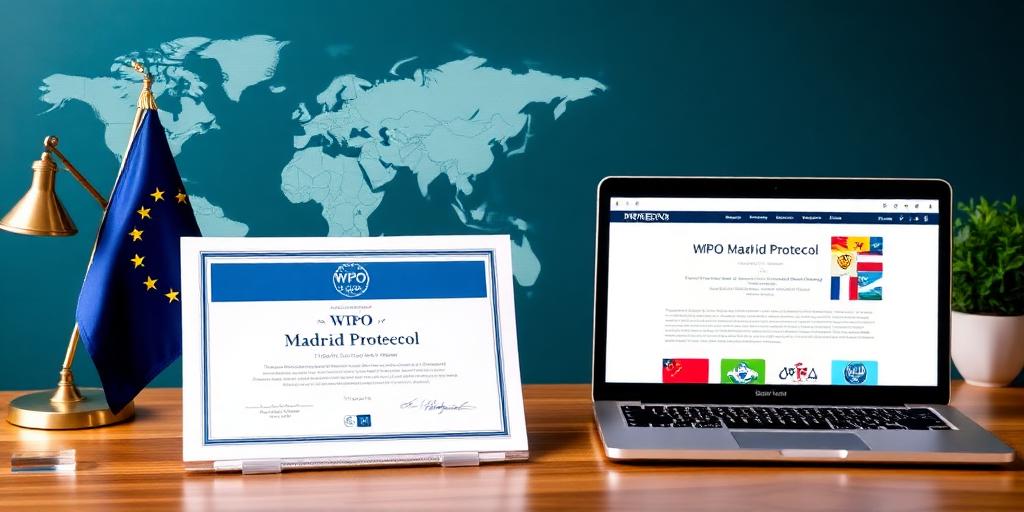
If your company is expanding beyond its home market, one of the first strategic decisions is how to protect your brand internationally. Two routes dominate the conversation: filing an EU trademark (EUTM) at the EUIPO, or using the WIPO Madrid Protocol to file in multiple countries through a single international application. They solve different problems, and choosing the right one can save you tens of thousands of euros over the life of your brand.
EU Trademark (EUIPO) in a nutshell
An EU trademark is a single registration that covers all 27 EU member states. You file one application at the EUIPO, pay one set of fees, and — if granted — you own the mark across the entire Union. Government fees start at €850 for one class of goods or services, with €50 for a second class and €150 for each additional class. Examination typically takes 4–6 months if no oppositions are filed.
Madrid Protocol in a nutshell
The Madrid Protocol is an international filing system administered by WIPO in Geneva. It lets you file a single application, in one language, and designate any of 130+ member countries. You still get national registrations in each designated country, but you manage them through one central record. It requires a home ('basis') application or registration in your own country to build on.
Cost comparison for founders
- EU-only expansion: an EUTM is almost always cheaper and faster than designating each EU state via Madrid.
- EU + US + UK + a few more: Madrid usually wins on total government fees and — critically — on renewal and management costs ten years down the line.
- Just one or two extra countries: direct national filings can beat both, especially in jurisdictions with unusual formalities (e.g. Canada, Brazil).
Management complexity
Madrid's biggest hidden benefit is administrative. Renewals, address changes, ownership transfers and licence recordals happen once, centrally, instead of country by country. For a growing startup that plans to be in 8–15 markets within a few years, that alone can justify the route.
The trade-off is the 'central attack' rule: for the first five years, a successful challenge to your home ('basis') registration can bring down the entire international registration. That's why the choice of basis country — and the strength of that filing — matters.
Which should you choose?
- Selling only in the EU today, no near-term US or UK plans → file an EUTM.
- Selling in the EU plus 2+ non-EU markets → file an EUTM as your basis, then designate the extra countries via Madrid.
- US-first startup with EU expansion planned → file a USPTO application, then use Madrid to designate the EU and other markets.
Timing and first-to-file
Most jurisdictions — including the EU, China and most of Latin America — are first-to-file. Whoever files first generally wins, even if you were using the name earlier. If international expansion is on your 12-month roadmap, filing the basis application now and reserving your Madrid designations is almost always the right move.
How Sayadi Law can help
At Sayadi Law we specialise in intellectual property protection tailored to your industry. We register trademarks, patents and designs internationally, monitor for infringement, and draft the contracts that turn your IP into a durable business asset. Our fixed-fee packages give you predictable pricing and direct access to the lawyer handling your file — no billable-hour surprises.
If you'd like to discuss your IP strategy, send us a message via our contact form or email us at info@sayadilaw.com to schedule a consultation.